
You've Been Prompting AI Your Whole Career. You Just Didn't Call It That.

A couple years ago I was staring down a problem I'd dealt with a hundred times in my career, except this time it was sixty tasks in a project management sprint instead of a team member sitting across from me.
A product launch date got pushed two weeks. Every task had a due date tied to it, every description referenced the original announcement date, and I had a marketing plan exhibit that visualized the whole thing for leadership. Going through and updating all of it manually would have taken me close to an hour, assuming I didn't get pulled into something else along the way.
So I tried something. I asked Claude to look at the sprint, identify every existing due date, take the new launch date I gave it, and adjust everything accordingly. Then asked it to update the exhibit so I could hand leadership a clean, accurate plan the same day.
It worked. Not because I have some technical background. But because I gave it a clear brief. That's when it clicked for me. I'd been managing people for fifteen years. I already knew how to do this.
The prompt is the brief. The brief is the prompt.
If you've ever handed a copywriter a vague assignment and gotten back something completely unusable, you already understand the core principle of working with AI.
"Write me a press release people will want to read." That's a real prompt I would have typed a few years ago. It's also about as useful as walking up to a new team member and saying the same thing with zero context. What comes back will be generic, off-voice, and wrong for your audience, because you never told it who the audience was, what the tone should sound like, where it's being placed, what it needs to say, or what it should never say.
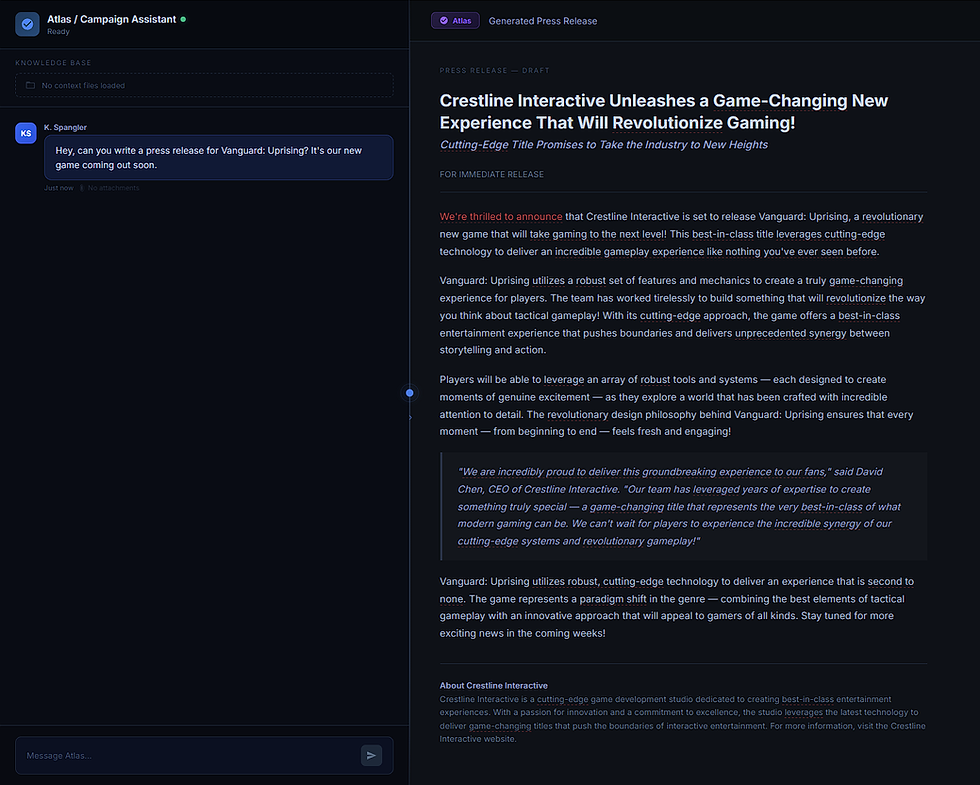

The quality of what comes back is a direct reflection of the quality of what you put in. You've known this your whole career. You just haven't applied it here yet.
The biggest mistake I see people make with AI is assuming it already knows what they're talking about. You need to go in assuming it knows nothing, because unless you've done the work to set it up properly with context, personalization and clear instructions, it doesn't. It's a talented team member on their first day who has never heard of your brand, your audience, or your goals. Brief it like that.
Feedback is iteration, not failure.
When a first draft comes back wrong, most people give up or start completely over. If you've managed a creative team, you know that's not how good work gets made. You give specific, directional feedback and go again.
AI is no different. "Make it shorter" is not feedback. "Cut this to three paragraphs, keep the second point, and remove the technical language in the last section because this is going to a general consumer audience" is feedback. That's direction. That's what moves the work forward.
The people who get frustrated after one bad output are usually the ones who never learned how to give a useful note. If you have, you're already working with an advantage here.
Where the comparison gets more complicated.
I won't pretend the analogy is perfect because it isn't, and anyone who has spent real time with these tools knows that.
A good employee pushes back when your brief is unclear. Here's the thing though. AI can do that too, but only if you've set it up to. If you've taken the time to configure your personalization settings, establish your preferences, and instruct it to ask clarifying questions before it runs with something, it will do exactly that. Most people skip that setup entirely and then wonder why they're getting outputs that miss the mark. The tool is only as good as the instructions you give it, and that includes telling it how to work with you.
The same goes for context. A team member who has worked with you for two years carries your brand voice, your preferences, your history. AI can carry that too, through projects, saved context, and proper setup, but you have to build it deliberately. It won't happen on its own. Once it's there though, every conversation starts from a foundation instead of from scratch, and that's where the real efficiency begins to show up.
Where to start.
Everything I've described here is the entry point. Stronger prompts, directional feedback, and understanding what AI needs from you to do its job. This is beginner level and I mean that as an on-ramp, not a limitation.
The next level is building a brand brief or system prompt. Think of it as the onboarding document you'd hand a new team member. Who you are, who your audience is, what your voice sounds like, what good looks like. Once that exists, you stop starting from zero every single time.
That's where I'm headed. But you don't need to start there.
If you've spent years learning how to give a clear brief, manage toward a vision, and get a creative team to produce work that actually lands, you're more prepared for this than you probably think.
Kathleen Spangler is a senior marketing professional with 16 years of experience in campaign execution, brand systems, and AI-integrated workflows.


Comments