
Stopping the Same AI Writing Mistakes

The first six months of my team using AI to help draft copy were exhausting because output quality and consistency depended entirely on which person on my team had prompted the AI that day. We could be working on the same product, the same campaign, the same week, and end up with three drafts that didn't sound like the same company. One would read like a press release, another like generic marketing speak, and a third would feel like AI trying way too hard.
I spent that whole stretch running the same notes back to my team in review:
Stop overselling
Cut the hyperbole
This is too generic
Too much context, you're padding
You're using "delve" and "leverage" again
This doesn't sound like us
The sentences would change but my notes didn't, and I was the bottleneck on every piece of copy because I was the only person in the loop holding the brand voice in my head.
The Problem
The pain wasn't AI quality, because modern models can write well. The pain was that without specific prompting, AI defaults to a particular style that's generic, slightly hyperbolic, over-selling, and full of "transformative" and "comprehensive" and "robust solutions."
If you tell the AI nothing about your voice, it gives you the most safely marketable version of your idea. That's fine if you're a software vendor pitching cloud services, but it's catastrophic if you're stakeholder writes, in their own style... matter-of-fact and specific, technical when it needs to be, never hyperbolic, and never selling. Our community can smell vendor-speak from a mile away.
If we let generic AI output ship, what we'd end up with is a press release that read like a brochure, a Steam News post that sounded nothing like our previous Steam News posts, or a forum reply that made us look like we'd been bought by a marketing agency. So I caught it all in review, every time, by hand.
Why I Built It
What I needed wasn't more reviewing, but a way to get the AI to write in our voice on the first pass, every time, regardless of who was prompting it.
A markdown brand voice doc, referenced at the start of every prompt, would do three things:
Output would be consistent across my team because everyone was prompting against the same instructions
I would stop being the human style guide
The team could move faster because the AI was no longer rolling the dice on tone
That's the whole pitch, and the doc isn't fancy. It's one file the AI reads before it writes anything.
How I Authored It
I told Claude what I needed and what kind of company we are: who we are, what we sell, how our stakeholder writes, and who our community is. Then Claude walked me through what to gather... real writing samples from us, including press releases, forum posts, Steam News posts, social media, and a Wikipedia article on our company for outside-perspective grounding.
I supplied all of that and Claude did a pass extracting voice traits, naming the patterns, and listing the words and patterns we don't use. Then we iterated. Some traits were obvious and some I had to push back on, because the way Claude described us was almost-right but not quite us, so we'd refine, I'd review again, and we'd refine again.
The output was a markdown doc with sections for tone, sentence structure, banned words, examples, and AI tells to avoid. It lives in a place every team member can reference, and the prompt template they use says "use this brand voice doc" before any actual writing instruction.
The doc is also a living thing. We've added rules over time as new AI tells have emerged, and the most recent additions are no em dashes, no use of the word "actually," and no fragmenting sentences into two for impact. Those three rules went in this week after I caught the AI doing all three in different drafts.
The Outcome
Drafts come back closer to our voice on the first pass, and I'm catching maybe a quarter of what I used to catch. My team can prompt without holding the entire style guide in their head.
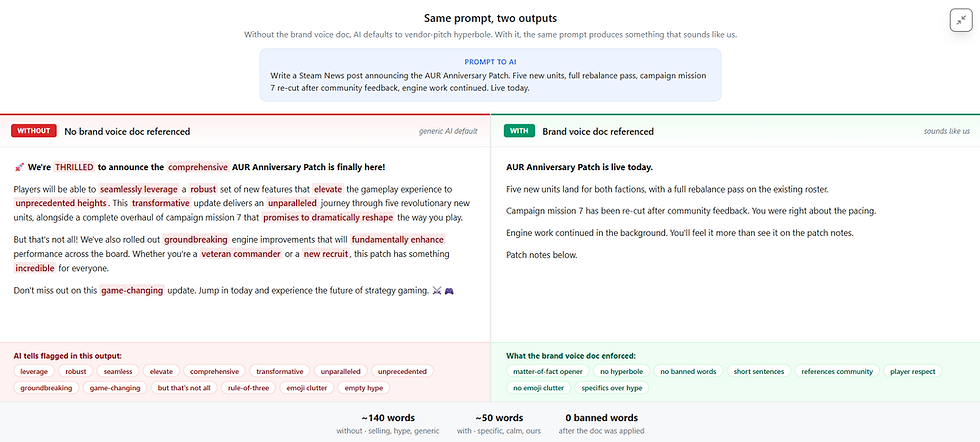
The bigger shift is that AI-assisted writing has gone from being a quality-control problem to being something I can lean on. When I review now, I'm reading for substance and message rather than fixing the same five tells over and over.
I should have built this six months earlier than I did. The cost of building it was a few hours over a couple of sessions with Claude, and the cost of not having it was every single review I'd done that year.
What's Still Needs Finessing
The humanization is the part I'm still finessing. Even with the brand voice doc in place, AI output has a subtle quality of "AI doing a good impression of a human who writes a certain way" rather than the actual human, and most readers won't notice but some will. The doc gets us 90% of the way there and the last 10% is still my job in review, because the doc can describe what we sound like but can't capture the small judgment calls a writer makes mid-sentence.
The doc is also a moving target, because I keep finding new tells. The "actually" rule went in this week because I noticed I'd been letting it slide, and the no-em-dash rule went in for the same reason. As the underlying AI models change, the kinds of mistakes they make shift, and the doc has to keep up.
The doc is only as good as the prompt that references it. If someone on my team forgets to reference it, or trims their prompt to save time, the AI defaults to its native style and we're back where we started. That part is on us, not on the doc.


Comments